
An inline shower filter is a separate filter body that fits between the shower arm and the shower head already on the wall. Water runs through the cartridge first, then out of the head. This guide follows the order in which a buyer usually decides: what the inline format is and how it differs from a filtered shower head and a hand-held filter shower, where it installs, what it does to flow, how cartridges are sized and replaced, and which format suits which kind of brand. The last section puts the three formats side by side, with the Jinko models that match.
| Inline filter | Filtered shower head | Handheld filter shower | |
|---|---|---|---|
| Where it sits | Between the shower arm and the head, or before a rain shower | Cartridge built into the head | Cartridge in the handle of a hand shower |
| Existing head | Kept | Replaced | Replaced by the hand shower |
| Cartridge room | Usually the most of the three | Limited by the head | Limited by the handle |
| Rain showers | Fits before an overhead head | Only if the head is the filter | Not used there |
| Look | Visible body on the arm | Hidden | Hidden in the handle |
| Typical buyer | Renters, hotels, people who like their head | People replacing a head anyway | Beauty brands, vitamin C ranges |
What an inline shower filter is (and how it differs from a filtered shower head)
There are three common ways to put a cartridge in a shower:
- Inline filter. A filter body on its own. The shopper keeps the shower head they have and adds the filter in front of it.
- Filtered shower head. The media sits inside the head itself, so the shopper replaces their head with the filtered one.
- Hand-held filter shower. The media sits in the handle of a hand shower. Jinko also makes this format; see our hand-held filter shower range.
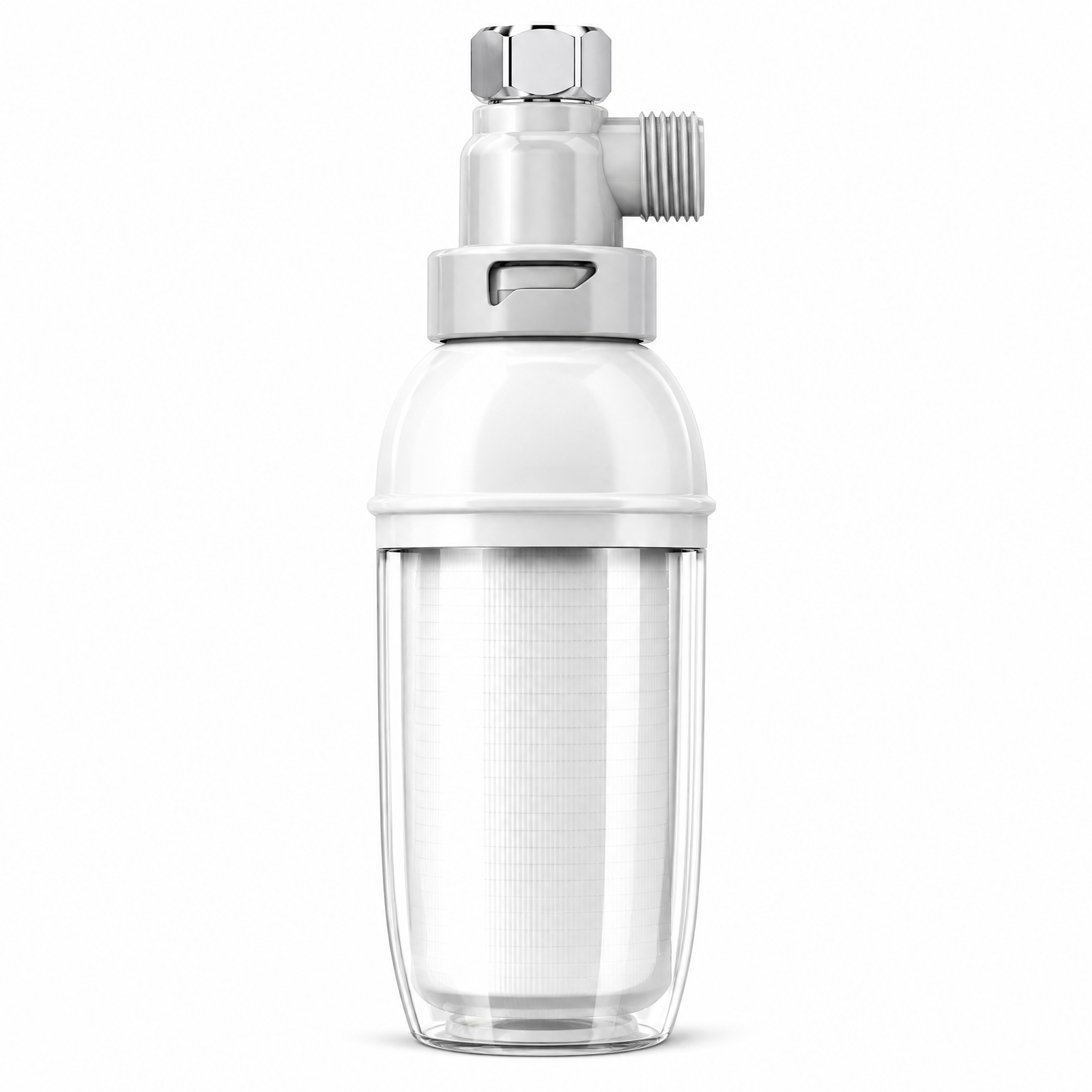
An inline unit has three parts: an inlet that threads onto the shower arm, a housing that holds the cartridge, and an outlet that the head threads onto. Because the housing sits outside the head, it can be larger than anything that fits inside a head, and that is where the extra cartridge room comes from. The cost is a visible body on the arm and one more threaded joint to seal. Retail listings spell the product several ways, including in-line shower filter and inline shower water filter. They all mean the same thing.
| Inline filter | Filtered shower head | Hand-held filter shower | |
|---|---|---|---|
| Where it installs | Between the shower arm and the head, or before an overhead rain shower | Replaces the head on the arm | Replaces the hand shower on the hose |
| Existing head | Kept | Removed | Removed |
| Joints added to the line | One extra threaded joint | None beyond the head itself | None beyond the hose connection |
| Room for media | Usually the most of the three | Limited by the size of the head | Limited by the size of the handle |
| Cartridge change | Open the housing and swap the cartridge | Open the head, on designs that take refills | Open the handle, on designs that take refills |
| What the shopper buys | Filter body and cartridge, no head | A complete head | A complete hand shower |
| Main trade-off | Longer, more visible assembly | Less media, head style is fixed | Less media, only for hand showers |
If you are comparing finished products rather than formats, our article on eight checks for comparing shower filters covers housing, cartridge, fit and claims.
Where an inline filter installs
Before the shower head
The most common set-up. The shopper unscrews the head, threads the filter onto the arm and puts the head back on the filter’s outlet. It is the reason the same product is often listed as an inline shower head filter: it lives directly behind the head.
Before an overhead or rain shower
On a rain shower, the filter goes on the arm or ceiling drop before the overhead head. Here clearance matters more. An inline body adds length between the wall or ceiling and the head, so a ceiling rain head sits lower and a low wall arm pushes the head further out. Ask your buyers to measure before they order, and put the filter length on your product page so shoppers can check it.
Jinko’s inline models are designed for both positions: before the shower head and before an overhead shower.
With a hand-held shower
There are two routes. An inline filter can sit where the hose starts, between the shower arm or outlet and the hose, so the hand shower stays as it is. Or the brand sells a hand-held filter shower, where the cartridge is in the handle and the shopper replaces the hand shower. The first suits shoppers who like their hand shower; the second gives a neater look and one product to sell.
Connection, ratings and what is in the box
Jinko’s inline filters use a G1/2″ connection and do not need an adapter, and they fit standard US 1/2″ NPT shower arms directly. Thread standards still vary between other markets, so check the thread used in your target market before you print “fits all showers” on a box. If your market uses a different standard, raise it with us at sample stage.
The rated operating range is 5 to 55°C and 0.1 to 0.5 MPa (about 14.5 to 72.5 psi, converted). The box contains the filter body and the cartridge. It does not include a shower head, which is worth stating clearly on a retail listing so nobody expects one.
Flow and water pressure: what a filter changes
Start with the limit on the head. Under the US federal standard, a showerhead may use no more than 2.5 gallons per minute (9.5 liters per minute), measured at a flowing pressure of 80 psi (10 CFR 430.32). Heads that carry the WaterSense label must use no more than 2.0 gpm (EPA WaterSense). Both figures describe the showerhead under a test condition. They are not what every home gets at the arm, and they are not a rating for the filter.
A filter adds resistance in front of the head. How much depends on three things: how densely the media is packed, how water moves through the housing, and how clogged the cartridge has become. Over the life of a cartridge, clogging is the most common reason the shower feels weaker.
One independent test, published by a US water filter review site, shows how wide the range can be. With a baseline of 1.72 gpm at 48 psi static pressure, the filters it tested kept between 82% and roughly 100% of the baseline flow. The same test noted that flow and pressure dropped noticeably as cartridges neared the end of their capacity. That is one setup with one set of products, so read it as an example, not a rule. In homes where pressure is already low, any drop from a filter can be more noticeable.
How to write a flow spec for your listing
“No pressure loss” is the claim shoppers see most often, and it is the hardest to defend. A spec that says how it was measured is more useful:
- State the test pressure, and whether it was static or flowing.
- Say whether a new, full cartridge was installed.
- Say whether the figure was taken with a shower head attached, and which one.
- Give flow in both gpm and L/min if you sell outside the US.
- Run the test on your approved sample, with the head you plan to recommend, and keep the record.
Cartridge capacity and replacement
Cartridge capacity comes down to two things: the internal volume of the housing and how much media fills it. An inline housing usually has more room than the cavity inside a filtered head, so it can hold more media. That is a comparison between formats, not a promise about any particular product.
Jinko recommends replacing the cartridge every 3 to 6 months. The real interval depends on local water and how much the shower is used. Our guide to changing shower filter cartridges covers the signs that a cartridge is due.
What goes inside Jinko’s inline cartridges
- JK-S3: a clip-in, horizontal design that makes cartridge changes easy, and our main model. It can be configured with PP cotton plus calcium sulfite, a carbon rod or a carbon fiber cartridge.
- JK-S4, JK-S5 and JK-S6: a composite cartridge of carbon fiber, copper-zinc (KDF-type) media, calcium sulfite and vitamin C.
If you plan a vitamin C inline shower filter, the S4, S5 and S6 are the place to start; read what a vitamin C shower filter is for the background. For the copper-zinc layer, see how KDF-type media works.
Which cartridges are shared
The JK-S4, JK-S5 and JK-S6 take the same cartridge. The JK-S3 has its own. C5, a new model, also has its own cartridge, which does not fit the other models. For a brand, this decides how many refill SKUs you stock. If you sell two or three housings from the shared group, one refill serves all of them. If you add the S3, you add a second refill line. Print the compatible models on every refill pack so customers and your support team do not mix them up.
Some shoppers search for an inline water softener for the shower. An inline filter is not a water softener, so do not market these cartridges as reducing hardness or scale.
Which format fits which brand
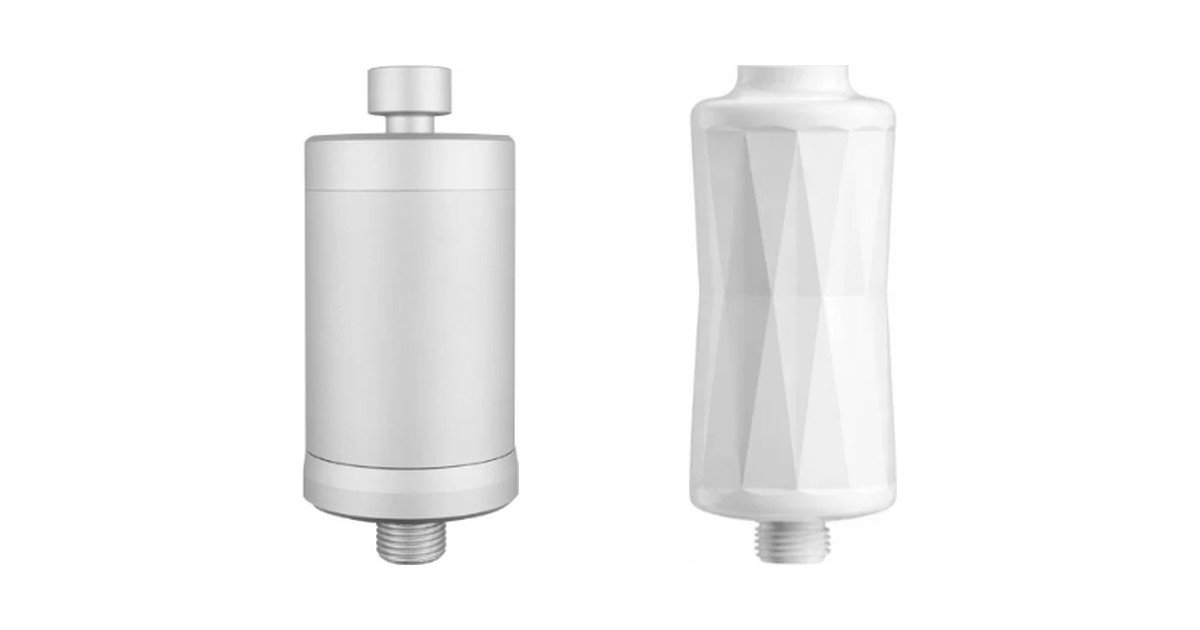
- Your customers want to keep their own shower head, or you sell into rain shower set-ups: go inline. The JK-S3 is the main model. The JK-S4 has a diamond-cut look if you want the housing to stand out on the shelf. The JK-S6 has an aluminium alloy housing for a premium line. The JK-S5, a new model, adds a filter reminder ring.
- You want to sell filter and head as one purchase: a filtered head or a hand-held filter shower suits you better. For the hand-held route, look at Jinko’s hand-held models.
- Your business depends on repeat refill sales: build the range inside the shared cartridge group (S4, S5, S6), so one refill covers every housing you sell. Treat the S3 as a separate line with its own refill.
Housing materials and customization
Plastic housings are ABS or PP. The metal option is aluminium alloy. Customization depends on the model:
- JK-S3: logo, packaging, instruction manual and cartridge configuration.
- JK-S4, JK-S5, JK-S6 and C5: the same, plus color and surface finish.
- Logo, packaging and manual are standard services. A custom cartridge, color or surface finish is evaluated for each project.
- Logo methods: laser engraving, screen printing or hot stamping.
Jinko can provide CE and RoHS documentation. If you are still deciding how much of the product you want to own, our article on OEM, ODM or private label lays out the options. Filtering a bath is a different product with different fittings; our bathtub water filter guide explains the formats there.
Inline vs filtered head vs hand-held filter: summary
| Format | Where it installs | Keeps existing head | Room for media | Cartridge change | Fits this brand strategy | Jinko match |
|---|---|---|---|---|---|---|
| Inline shower filter | Before the shower head, or before an overhead rain shower | Yes | Usually the most | Open the housing, swap the cartridge; every 3 to 6 months | Customers keep their head; rain shower set-ups; refill programs | JK-S3 (own cartridge); JK-S4, JK-S5, JK-S6 (shared cartridge). G1/2″, no adapter, 5 to 55°C, 0.1 to 0.5 MPa |
| Filtered shower head | Replaces the head | No | Limited by the head | Open the head, on refillable designs | One-box sale of filter and head | Not covered in this guide |
| Hand-held filter shower | Replaces the hand shower | No | Limited by the handle | Open the handle, on refillable designs | One-box sale for hand shower users | Hand-held range, linked above |
For the full product line and OEM terms, see our private label shower filter manufacturing page.
The quickest way to choose between inline housings is to hold them. Ask for a sample set of the JK-S3, JK-S4 and JK-S6: the clip-in main model, the diamond-cut body and the aluminium alloy body, side by side. Tell us your target market, sales channel, expected quantity and whether you need customization. Existing samples take 2 to 3 days and customized samples 5 to 7 days. Where a sample fee applies, it can be credited against your order. Request the S3, S4 and S6 sample set, and we will come back with pricing and options for the Jinko inline filter models you choose.