
Do shower filters help hair? They can help a little, mainly by reducing the chlorine in your shower water, which some people find leaves their hair drier and rougher. A typical shower filter does not soften hard water, and there is no good evidence that it prevents or reverses hair loss. If your hair problem comes from chlorine, you may notice a difference. If it comes from hard water, styling, products or a medical cause, a filter will not fix it.
Below: what the research says, what a filter can and cannot change, how to judge a “before and after” fairly, and when it is worth trying one.
What the research says about water and hair
There are no good clinical studies that test shower filters on hair directly. What exists are lab studies on hair strands soaked in different kinds of water, plus studies on swimmers.
| Question | What studies found |
|---|---|
| Does hard water weaken hair? | Mixed. One lab study found no difference in strength or elasticity between hair soaked in hard water and in distilled water for 30 days (Srinivasan et al., 2013). Two later studies from Pakistan, using hair soaked in very hard water for up to 3 months, found the hair became weaker (Luqman et al., 2016; Luqman et al., 2018). |
| Does chlorine damage hair? | In pools, yes. A study of elite swimmers found hair discoloration in 61% of them and damage to the hair cuticle under the microscope (Nanko et al., 2000). Swimmers spend hours a day in pool water, so this does not show what a few minutes of chlorinated tap water does, but it explains why people with dry or color-treated hair often want less chlorine. |
| Does water cause hair loss? | Not among the known causes. The American Academy of Dermatology lists 18 common causes of hair loss, including genetics, hormones, stress, illness, hairstyles and nutrition. Shower water is not one of them. |
What a shower filter can and can’t change
Most shower filters use media such as calcium sulfite, copper-zinc (KDF-type) media, vitamin C or carbon. These are chosen to reduce chlorine in the water as it passes through. A sediment layer catches sand and rust.
- Can change: chlorine. This is the main job of a shower filter. If your hair feels rough or dry after showering on chlorinated city water, this is the part a filter can help with. See how chlorine affects hair.
- Cannot change: hardness. Calcium and magnesium are dissolved in the water and pass straight through a shower cartridge. If mineral buildup is your problem, you need a water softener, or a clarifying or chelating shampoo. Our guide to shower filters and hard water explains the difference.
- Cannot change: hair loss. A filter does not treat hair loss. If you are losing more hair than usual, see a dermatologist.
- Depends on the cartridge. A cartridge only works while its media lasts. An old cartridge does very little. See how long a shower filter lasts.
Hair before and after a shower filter: what to look for
Before-and-after photos online are easy to stage. Different lighting, a fresh haircut or a new conditioner can change hair more than the water does. If you want to judge for yourself, keep the test fair:
- Change one thing only. Keep the same shampoo, conditioner, styling and wash schedule.
- Give it 4 to 6 weeks. Hair feel can change within days, but you need several washes to tell a real difference from a good hair day.
- Take photos the same way. Same room, same light, same time after washing, hair dried the same way.
- Note what you can feel. Softness when wet, how easily you can comb it, frizz, how long color stays bright. These are more reliable than photos.
- Know your water first. Check your utility’s water report for chlorine or chloramine and for hardness. If your water is soft and lightly chlorinated, expect little change.
When a shower filter is worth trying for hair
- You are on chlorinated city water and your hair feels dry or straw-like after showering.
- You color your hair and want to reduce one of the things that can make color fade.
- You notice a chlorine smell in the shower.
It is probably not the answer if your main problem is scale and buildup from hard water, product buildup, heat damage, or hair loss.
Do shower filters help hair: FAQ
Are shower filters good for hair?
They can be, if chlorine in your water is part of the problem. They are not a hair treatment, and the effect depends on your water and on keeping the cartridge fresh.
Does a shower filter help with hair loss?
There is no good evidence that it does. Hair loss usually has other causes, such as genetics, hormones, stress or illness. See a dermatologist if you are worried.
Will a shower filter remove hard water minerals from my hair?
No. A shower filter does not remove calcium and magnesium. For mineral buildup, use a water softener or a chelating shampoo.
How long until I see a difference?
If chlorine is the issue, some people notice softer hair within a few washes. Give it 4 to 6 weeks, with nothing else changed, before deciding.
Which shower filter is best for hair?
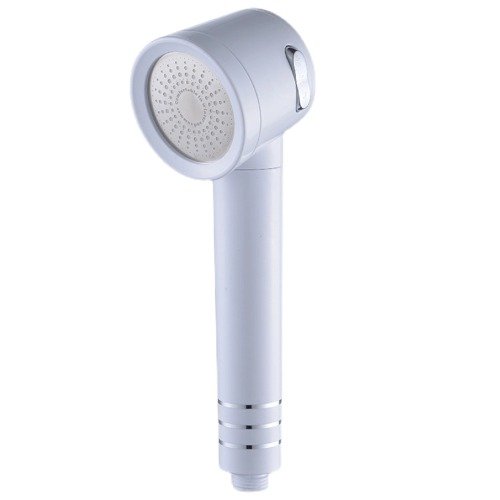
Look for media aimed at chlorine (such as vitamin C, calcium sulfite or KDF-type media), a cartridge you can easily replace, and a change interval printed on the box. A hand-held filtered shower head is easier to aim when rinsing long hair. See our vitamin C shower filter guide.
For brands: talking about hair honestly
Hair is one of the main reasons people buy shower filters, and it is also where claims go too far. “Reduces chlorine in your shower water” is supportable. “Stops hair loss”, “removes hard water minerals” or a percentage figure without a test report are not. Jinko makes hand-held and inline shower filters for private label brands, with cartridge options including vitamin C and copper-zinc (KDF-type) media. See our hand-held shower filter range or contact us about a hair-care line.
Sources
- Srinivasan G, et al. Effects of hard water on hair. International Journal of Trichology, 2013;5(3):137–139. PubMed 24574692
- Luqman MW, et al. Effect of topical application of hard water in weakening of hair in men. J Pak Med Assoc, 2016;66(9):1132–1136. PubMed 27654734
- Luqman MW, et al. To evaluate and compare changes in baseline strength of hairs after treating them with deionized water and hard water and its role in hair breakage. International Journal of Trichology, 2018;10(3):113–117. PubMed 30034190
- Nanko H, et al. Hair-discoloration of Japanese elite swimmers. Journal of Dermatology, 2000;27(10):625–634. PubMed 11092265
- American Academy of Dermatology. Hair loss: who gets and causes