
Microbubbles are air bubbles smaller than about 100 microns, far smaller than the bubbles in a bubble bath. When a shower head or tap filter mixes them into the water, the stream turns milky white and feels softer on the skin. Their best-supported benefit for skin is cleansing: lab tests show a bubbly water jet lifts makeup and residue off skin-like surfaces better than plain water. Claims about extra oxygen, negative ions, collagen or curing eczema are not supported by the research so far.
This guide covers what microbubbles do on your skin, what the studies actually found, who may notice a difference, and how to get the most out of a microbubble shower in your skincare routine.
What are microbubbles?
“Fine bubbles” is the umbrella term. Researchers usually call bubbles under 100 µm (0.1 mm) microbubbles and bubbles under 1 µm ultrafine bubbles or nanobubbles, as described in a 2025 clinical study in the Journal of Dermatology. A normal bubble in bath foam is many times larger.
Small bubbles behave differently from big ones. They rise slowly, so they stay in the water longer, and together they have a very large surface area for their volume. When they hit a surface or burst, they create small, local agitation. A 2024 study in Scientific Reports describes these three properties as the reason fine bubbles are studied for cleaning.
Most microbubble shower heads and tap filters need no power. Water is pushed through a narrow passage, the pressure drops, and air comes out of the water or is drawn in through small holes as fine bubbles. Our guide to the microbubble shower head explains the hardware in more detail.
Why the water looks milky
Millions of tiny bubbles scatter light, so the water looks white or cloudy. Leave a glass of it for a moment and it clears from the bottom up as the bubbles rise and burst. The milky look is simply air. It does not mean the water has been sterilized or enriched with anything.
Microbubble skin benefits: what the research shows
| Benefit people talk about | What the evidence says |
|---|---|
| Better cleansing | Supported in the lab. In the 2024 Scientific Reports study, a hand-held bubbly jet removed foundation and lip tint from artificial skin and synthetic leather much better than a plain water jet, even without detergent. The authors put this down to the higher energy of the jet and bubbles striking the cosmetic directly. |
| Gentle on sensitive skin | Early support. In a double-blind crossover trial, 23 adults with mild atopic dermatitis used a fine bubble shower and a conventional shower. The fine bubble shower was well tolerated and did not worsen their skin over 4 weeks (Kato et al., J Dermatol, 2025). It was not shown to be better than a normal shower, and the shower maker funded the study. |
| Relief from eczema or psoriasis | Not proven. A mouse study found ultrafine bubble showers reduced dermatitis in one allergy model but not in another (Matsumoto et al., Frontiers in Immunology, 2024, co-funded by a bubble equipment maker). A small open-label pilot of microbubble baths for eczema, psoriasis and other skin diseases is still running at Northwestern University, with results expected after 2026. |
| More oxygen in the skin, collagen, anti-aging | No good evidence. Oxygen micro/nanobubble water has been studied for medical infusion fluids in the lab (Matsuki et al., 2014), but that used pure oxygen, not the air in a shower, and did not test skin. |
| Negative ions, “detox”, sterilization | No evidence from skin or shower studies. We do not make these claims. |
So the honest summary is: microbubbles can help water clean the skin surface, and early data suggest they are gentle. The bigger health claims you often see online come from marketing, not from studies on people.
How microbubbles help cleanse the skin
Pores and the fine lines of the skin hold oil, sunscreen and makeup that plain running water does not fully lift. Fine bubbles carried in the water stream reach into these small spaces and break against the residue, which helps loosen it. In the 2024 lab study, this happened without soap.
That is why many people who switch to a microbubble shower notice that their skin feels cleaner after rinsing, or that they need less cleanser for the same result. Using less cleanser can help if your skin feels tight or dry after washing. It does not mean you should stop using soap where you need it.
Microbubbles and dry or sensitive skin
If your skin is easily irritated, the clinical result above is the useful part: in adults with mild atopic dermatitis, a fine bubble shower did not make things worse over four weeks. Treat a microbubble shower as a gentle way to rinse, not as a treatment. If you have eczema, psoriasis or acne that needs care, keep following your dermatologist’s plan.
Your water matters too. In many cities, tap water contains chlorine, which some people find drying. Read more on how chlorine affects your skin and on filtered water and skin health. Some hand-held microbubble shower heads also hold a filter cartridge, so you can address both in one product.
Microbubble therapy vs a microbubble shower
“Microbubble therapy” usually means a bathtub system, often in a walk-in tub, that fills the bathwater with microbubbles while you soak for 15 minutes or more. A shower is different: each part of your skin is in the stream for seconds, and the bubbles exist only while the water runs. Results reported for therapy baths should not be expected from a shower head.
How to use a microbubble shower for your skin
The American Academy of Dermatology’s tips for dry skin apply to any shower, microbubble or not:
- Use warm water, not hot, and keep the shower to about 5 to 10 minutes.
- Use a gentle cleanser, and only where you need it. With a microbubble stream you may find you need less.
- Pat your skin dry instead of rubbing.
- Moisturize right away, while your skin is still slightly damp.
To keep the bubble effect working, clean the spray face from time to time. In hard water, mineral scale can block the small nozzles. If your head holds a filter cartridge, change it on time; see how long a shower filter lasts.
Microbubble skincare at the sink
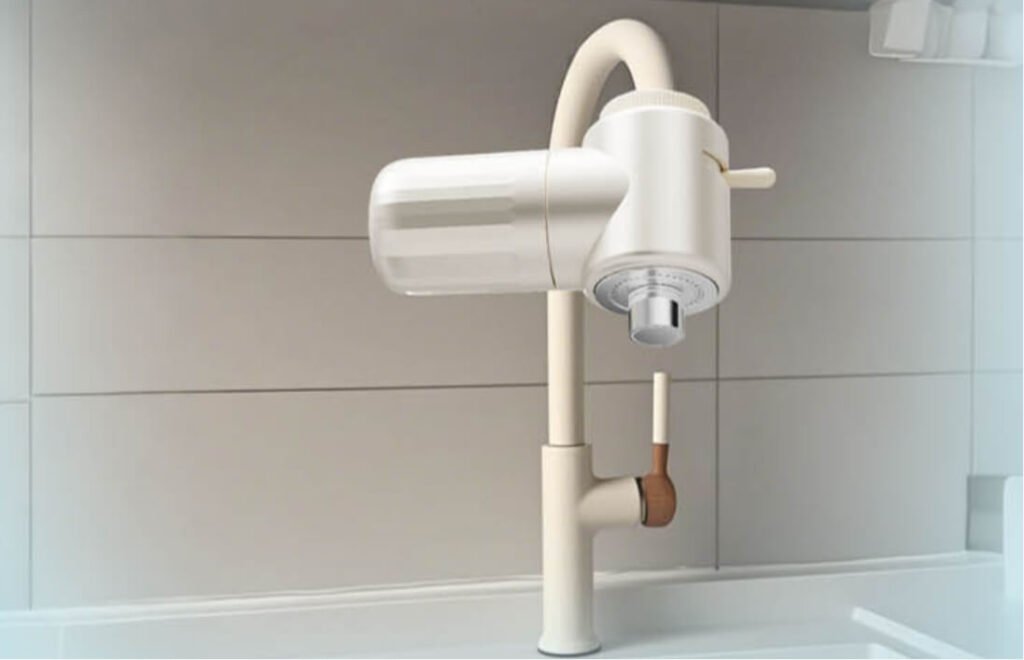
You can also get microbubbles at the bathroom tap, for washing your face. Jinko’s H1 series skincare micro bubble faucet filter fits on the tap and combines a filter with a bubble outlet, so the water you wash with is both filtered and full of fine bubbles.
Microbubbles for skin: FAQ
Can microbubbles get into pores?
Microbubbles are small enough to reach into pores and the fine texture of the skin, and lab tests show they help lift residue from skin-like surfaces. They do not “penetrate” into the skin itself.
Do microbubbles hydrate the skin?
There is no good evidence that microbubbles add moisture to the skin. A gentler, quicker cleanse followed by moisturizer is what helps skin stay hydrated.
Are microbubbles safe for sensitive skin and children?
A microbubble shower is just water and air. In the one controlled trial on people with mild atopic dermatitis, it was well tolerated. If a child has a skin condition, ask their doctor about bathing routines.
Do microbubbles help eczema or psoriasis?
Not proven. Studies so far show the fine bubble shower is gentle, and research on microbubble baths for skin diseases is still under way. It should not replace treatment.
Are tiny bubbles that form on my skin the same thing?
No. Small bubbles of air that cling to your skin in a bath or glass of water are normal. Fluid-filled bumps or blisters on the skin are a different matter and are worth showing to a doctor.
For brands: microbubble shower heads from Jinko
Jinko is a shower filter and water filtration factory in Foshan, China. We make OEM and ODM microbubble shower heads for private label brands, including hand-held models that can hold a filter cartridge, as well as the H1 micro bubble faucet filter. If you plan to sell microbubble skincare products, see what to check in a microbubble shower head, including which claims to keep off your packaging, then contact us with your target market and quantity.
Sources
- Kato H, et al. Safety evaluation of fine bubble shower washing for patients with atopic dermatitis: a double-blind, randomized, prospective crossover clinical trial. Journal of Dermatology, 2026;53(3):447–453 (online December 2025). PubMed 41404883
- Kang Y, et al. Toward the eco-friendly cosmetic cleansing assisted by the micro-bubbly jet. Scientific Reports, 2024;14:8189. PMC11001607
- Matsumoto et al. Beneficial effects of ultrafine bubble shower on a mouse model of atopic dermatitis. Frontiers in Immunology, 2024. Article
- Thera-Clean Microbubbles System in Patients With Skin Diseases (pilot study, Northwestern University). NCT07050810
- Matsuki et al. Oxygen supersaturated fluid using fine micro/nanobubbles. International Journal of Nanomedicine, 2014;9:4495–4505. PMC4181745
- American Academy of Dermatology. Dermatologists’ tips for relieving dry skin