
How often to replace a shower filter? Use the service interval or verified capacity for the cartridge in that housing. If you cannot verify either, follow the model instructions and inspect the fit, flow, seals and the water issue the cartridge is designed to address. Never borrow a month or volume claim from another cartridge.
A reminder tells you when to inspect the filter. It does not prove the media are spent. Your replacement rule should name the cartridge, the evidence behind the rule and the conditions that apply. A pressure change, chlorine-like odor, leak or white scale each calls for a different check.
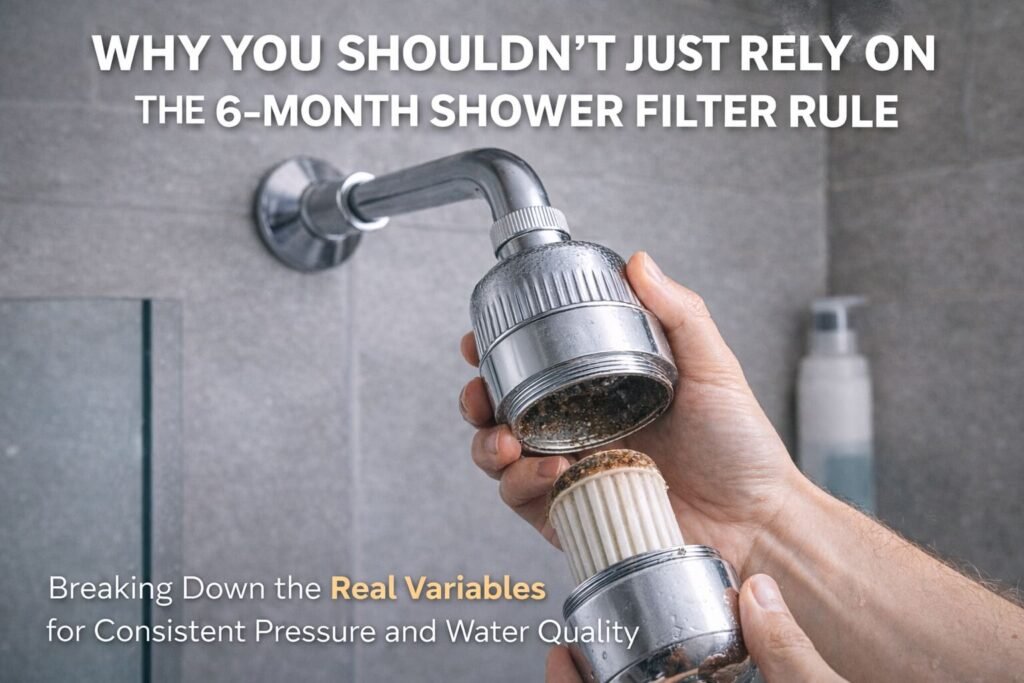
Use the cartridge record, not a generic month range
Two cartridges can fit the same type of housing and still use different media loads, water paths or service conditions. Record the housing model, cartridge model and refill part number before you set an interval. Then check how the manufacturer defines replacement for that cartridge. The instruction may use time, treated volume, a measured endpoint or more than one limit.
When you have a verified capacity for the selected cartridge, measured shower use can help you estimate a review date:
Daily water use = measured flow x average shower time x total showers per day
Estimated service days = verified cartridge capacity / measured daily water use
Use that estimate only when the capacity belongs to the same cartridge and the test conditions cover the intended water, temperature and flow. Without those details, the result can help you plan stock. It cannot support a product-life claim.
Check the water problem before you check the media
Free chlorine and chloramine are different disinfectants. The U.S. EPA explains how chloramines are used in drinking-water systems. If your market uses chloramine, request evidence that names chloramine and the tested cartridge. A free-chlorine result does not cover it.
NSF states that NSF/ANSI 177 for shower filters addresses free available chlorine reduction. That scope does not automatically cover chloramine, hardness, heavy metals or every statement on a product page.
The media name alone cannot tell you the service life. KDF, calcium sulfite, activated carbon and Vitamin C cartridges can all vary in media loading and water path. For refill sourcing, compare Jinko’s KDF and Vitamin C cartridge options and the separate Vitamin C shower filter guide.
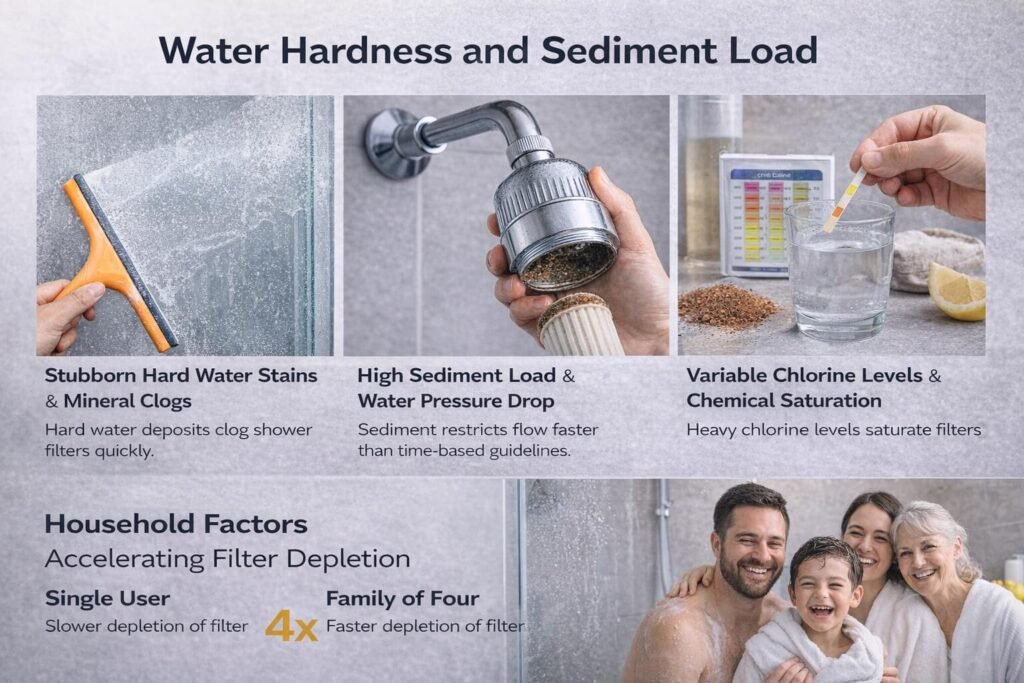
Read each replacement warning sign separately
| What you notice | What it may mean | What you should do |
|---|---|---|
| The approved service interval or capacity has been reached | The cartridge may be at its documented replacement point | Replace it according to the instructions for that model |
| Pressure falls gradually after normal use | Sediment may be blocking a screen or the cartridge | Inspect the housing and follow the model instructions for cleaning or replacement |
| A chlorine-like odor returns | Chlorine reduction may have declined, or the incoming water may have changed | Use a suitable chlorine test only if chlorine reduction is within the product’s stated scope |
| Pressure falls immediately after installation | The cartridge direction, washer, housing or fit may be wrong | Turn off the water and check the installation instructions for that model |
| The housing leaks or an O-ring is damaged | The filter has a mechanical or sealing problem | Stop using it until you correct the seal or replace the damaged part as instructed |
| White scale and soap scum remain | The water may contain dissolved hardness minerals | Do not treat scale as proof that chlorine-reduction media are spent |
One symptom can have more than one cause. Normal pressure does not prove that treatment media are still working. Skin feel and hair texture are weak replacement signals too, since personal-care products, humidity, temperature and water hardness can change them. If the problem is a leak, use the shower filter leak inspection guide and the instructions for the model in front of you.
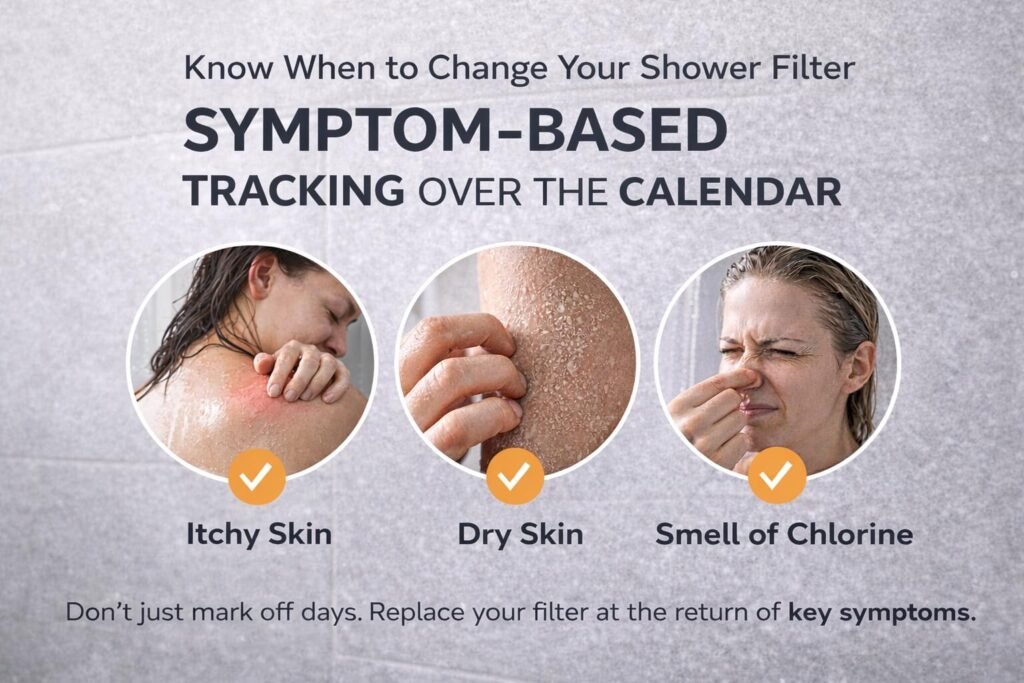
Hard-water scale does not prove the cartridge is spent
Hard water mainly contains dissolved calcium and magnesium. The U.S. Geological Survey’s hardness guide explains why those minerals can leave scale and react with soap. A standard shower filter does not necessarily remove them.
For a chlorine-reduction requirement, check the chlorine evidence for the selected cartridge. For a white-scale complaint, assess a treatment method designed for hardness. Changing a chlorine-reduction cartridge more often will not turn it into an ion-exchange water softener.
Keep a replacement record your support team can use
Your customers, distributors and support staff need the same replacement rule. Keep it with the approved product record rather than printing one generic date across several cartridge versions.
| Record | What to capture | Why it matters |
|---|---|---|
| Approved configuration | Housing model, cartridge model, media version and refill SKU | Prevents a rule from one cartridge being copied to another |
| Evidence basis | Instruction revision, test file, capacity basis and applicable conditions | Shows what supports the published replacement rule |
| Installation record | Install date, location and any available use or flow information | Helps your team plan the next review and investigate early blockage |
| Inspection result | Flow change, leakage, visible sediment and any test result within scope | Separates mechanical, sediment and treatment-performance questions |
| Replacement record | Date, reason, replacement SKU and batch or lot reference | Supports complaint handling and repeat-order planning |
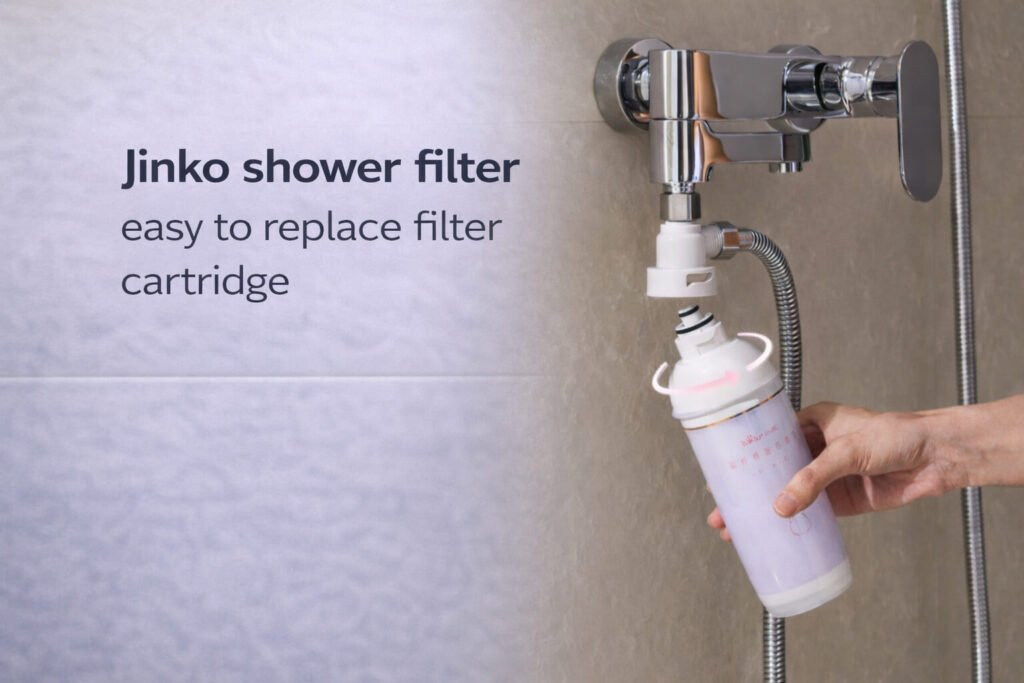
How to replace a shower filter cartridge
Match the replacement cartridge to the housing model before you open the filter. A similar shape does not prove compatibility.
- Turn off the shower and let the housing drain.
- Open the housing as shown in the instructions for that model.
- Remove the used cartridge, then inspect the housing, gasket and O-ring.
- Insert the approved replacement cartridge in the required direction.
- Reassemble the housing, flush the new cartridge as instructed and check for leaks before normal use.
Do not rinse and reuse treatment media unless the model instructions allow it. A washable sediment screen may be reusable. Rinsing does not restore activated carbon, KDF, calcium sulfite or Vitamin C after the applicable working capacity has been reached.
Buyer checklist for a refill and maintenance program
The replacement rule affects your manual, refill stock, packaging and customer support. Check each item below against the configuration in the quotation and approved sample:
- Put the housing model, cartridge model and refill SKU on the quotation and approved specification.
- Check the cartridge direction, seal fit and housing compatibility with the physical sample.
- Match every treatment and service-life statement to the applicable model, media and evidence file.
- Read the inlet conditions, flow, temperature, treated volume and endpoint behind any capacity statement.
- Approve the replacement, flushing and leak-check instructions while you review the sample.
- Keep the refill label, manual and packaging artwork tied to the same approved rule.
- Decide how you will identify refill batches and handle an early-pressure-loss or leakage complaint.
- Set the reorder point and spare-cartridge pack before the first product shipment.
Review Jinko Filter’s shower filter and replacement cartridge configurations. If you are sourcing across several water-filter categories, compare the current product range and project inputs before you lock the refill program.
Send the cartridge and market brief
Send the housing or cartridge model, target market, local water information, preferred media, packaging scope, expected order quantity and required documents. Jinko can check the requested configuration and identify which available files apply to that model.